Showing posts with label Arizona. Show all posts

Monday, February 17, 2014

The Wave and The Civil Wars


The Civil Wars released a new album called Between the Bars recently, which featured a album cover that looked oddly familiar to me. It is The Wave, part of the Paria Canyon Vermilion Cliff Wilderness Area in northern Arizona.

What it is about this place that captures the imagination? For once I won't try to guess but leave you, the reader, with images from my visit to the wave and let you decide. Make sure to listen to the tunes and see if you think they match the place on the cover.


Monday, October 29, 2012

Edward Abbey

I have no clue how I missed this speech by Edward Abbey. For anyone who has visited the Southwest or read one of Abbey's books this is a must listen. He strikes me in the video more like Hunter S. Thompson than I had ever realized before now, great Americans the both of them. Here Abbey talks about one of the subjects he cared most about, life before the Glenn Canyon Dam. The speech is in three parts.


Tuesday, February 21, 2012

In Search of the Frontier


Life in Crown King has been for me a search for a new frontier. In the past year I have been fortunate enough to live a life filled with moments somewhere between car commercials and national park highlight reels. On one coast, I have worked on a 30,000-acre National Wildlife Refuge. Somewhere in the Southwest I have dropped into canyons no wider than my extended arms. On my way to Crown King, I hiked the narrows of an ice-covered river. These were the stories that preceded my arrival to the town of Crown King, Arizona, located in the fourth state I have called home in less than a year.


Saturday, December 24, 2011

My Own Finding Everett Ruess

“Somehow, I am very glad not to be home, where civilized life thrusts the thought of money upon one from all sides. With an adequate stock of provisions, I can forget the cursed stuff, or blessed stuff, for days and weeks at a time.” – Everett Ruess
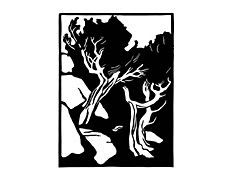
Artwork by Everett Ruess

It is Christmas eve and my thoughts are about as far from home and the holidays as they could be. My mind is on an adventurer, painter and writer from the early 1930s, Everett Ruess. My obsession with Everett Ruess developed much like when you learn a new word and then find that word everywhere or learn a new bird song only to start hearing it in every forest. I was a fan before I knew his name. It is through his adventures in the early 1930s that I come to feel that I have come to better understand my own journeys through the landscapes of the desert southwest.

My first exposure to the life and death of Everett Ruess was through an NPR story on Finding Everett Ruess by David Roberts. The report talked about how others had compared Everett Ruess to legends in the sphere of nature writers such as John Muir. I could not believe I had never heard of him. Upon reading Finding Everett Ruess, I found out that he had been an artist, poet and avid letter writer as he learned a love of the outdoors in the Sierras, Arizona and Utah in the early 1930s.

Everett’s credit for adventure belongs to his jaunts in and around the southwest. Everett went on three different tours in the American southwest. The most impressive of which was in 1931 on a trip with almost the sole purpose of searching for beauty. Everett spent 10 months traveling to some of today’s most iconic western locales such as Monument Valley, Tsegi Canyon system, Canyon de Chelly National Monument, Zion National Park and Grand Canyon all at the age of 17. In three years time, Everett would last be seen in the canyons outside Escalante, Utah.


Many of these places have come to mean a great deal to me. Zion was one of my first experiences with the beauty of southern Utah. The Grand Canyon remains a place where I could stare for hours entranced and never failing to find something new in the landscape. The area Everett last explored, the canyons of Escalante and Glenn Canyon, had enticed me with their ruggedness before I ever knew their connection to Everett Ruess. Even today, the solitude provided by the challenge of getting around in the canyons is almost unmatched in the lower forty-eight states.

I soon leave for the southwest and mainly Arizona, a state Everett spent a great deal of time exploring. I plan on hiking near Escalante, Utah before making my way south. The place where I will live is in the same mountain range Everett passed through on a trip in 1931 from Prescott to Mesa, Arizona. Like Everett before me, I look forward to the time spent away from cities and in some mountain range or canyon with flowing water below and a blue sky above. I will wonder from time to time if I am setting under the same juniper or looking out over the same vista Everett Ruess did so many years ago.


Everett Ruess disappeared at the age of 20 years in 1934.

“These days away from the city have been the happiest of my life, I believe. It has all been a beautiful dream, sometimes tranquil, sometimes fantastic, and with enough pain and tragedy to make the delights possible by contrast. But the pain too has been unreal.” – Everett Ruess

Everett Ruess playlist on spotify

Thursday, September 8, 2011

"Encounters with the Archdruid"

I'm reading Encounters with the Archdruid: narratives about a conservationist and three of his natural enemies. Author John McPhee takes David Brower, former president of the Sierra Club, to meet a geologist, a developer and a commissioner of reclamation at sites threatened by the latter's idea of progress.

The third chapter is titled "A River," and Brower rafts down the Grand Canyon with Floyd Dominy, the man responsible for building dozens of dams. They hit Havasu Canyon.

"A bend to the right, a bend to the left, right, left — this stone labyrinth with a crystal stream in it was moment enough, no matter where it ended, but there lay beyond it a world that humbled the mind's eye."


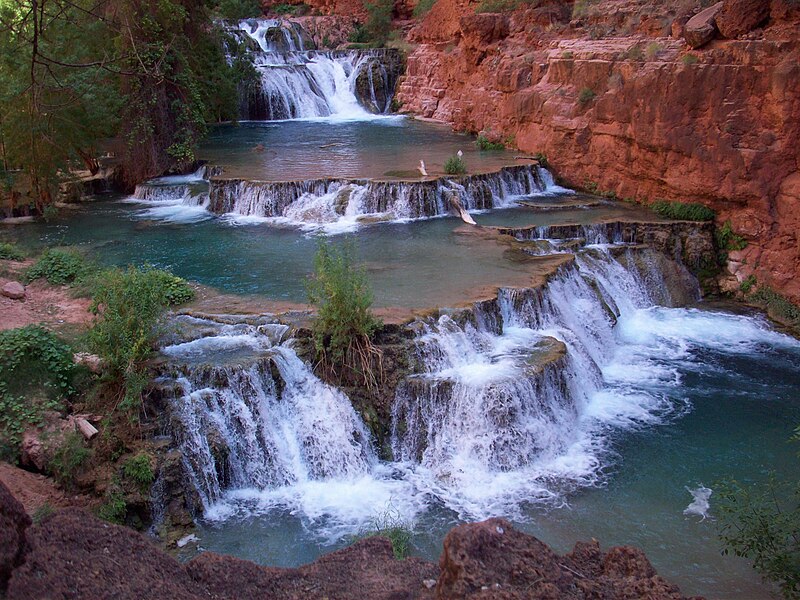
"The walls widened first into a cascaded gorge and then flared out to become the ovate sides of a deep valley, into which the stream rose in tiers of pools and waterfalls.  Some of the falls were only two feet high, others four feet, six feet."


"There were hundreds of them."


 "The pools were as much as fifteen feet deep, and the water in them was white where it plunged and foamed, then blue in a wide circle around the plunge point, and pale green in the outer peripheries. Mile after mile, the pools and waterfalls continued. The high walls of the valley were bright red."


"This was Havasu Canyon, the immemorial home of the Havasupai, whose tribal name means 'the people of the blue-green waters.'"


"Dominy was waiting below. 'It's fabulous,' he said. 'I know every river canyon in the country, and this is the prettiest in the West.'"

This is what Encounters does: paint stunning scenes and juxtapose them with men supposedly who rather profit from a place than admire it. McPhee, however, gives these characters humanity and nuance. They know these lands better than Brower; they just don't think we can afford to preserve every inch of it.

At first, I disliked this book and then realized I actually disliked Brower, or at least the way he was characterized in the first part. He's consistently shown up on nature, knowledge and hiking by a geologist who wants to put a copper mine in the Cascade Mountains. In dialogue, the mining expert says something reasonable and Bower pipes up with something cliche like "population is pollution spelled inside out."

Later Brower mellowed out, and I found peace. It's a good story. There's definitely some stilted dialogue and an anemic amount of scenes and plots, but that's an issue with the concept. In just three parts, McPhee effectively shined light on the preservation -> conservation -> development gradient and challenged conceptions about each one.

So if that sounds like your kind of paperback, check out Encounters of the Archdruid by John McPhee, lent out at fine libraries nationwide. Maybe even bookstores! Definitely Amazon.